

Comparing Crypto Custody Solutions for 2025
A Quick Look

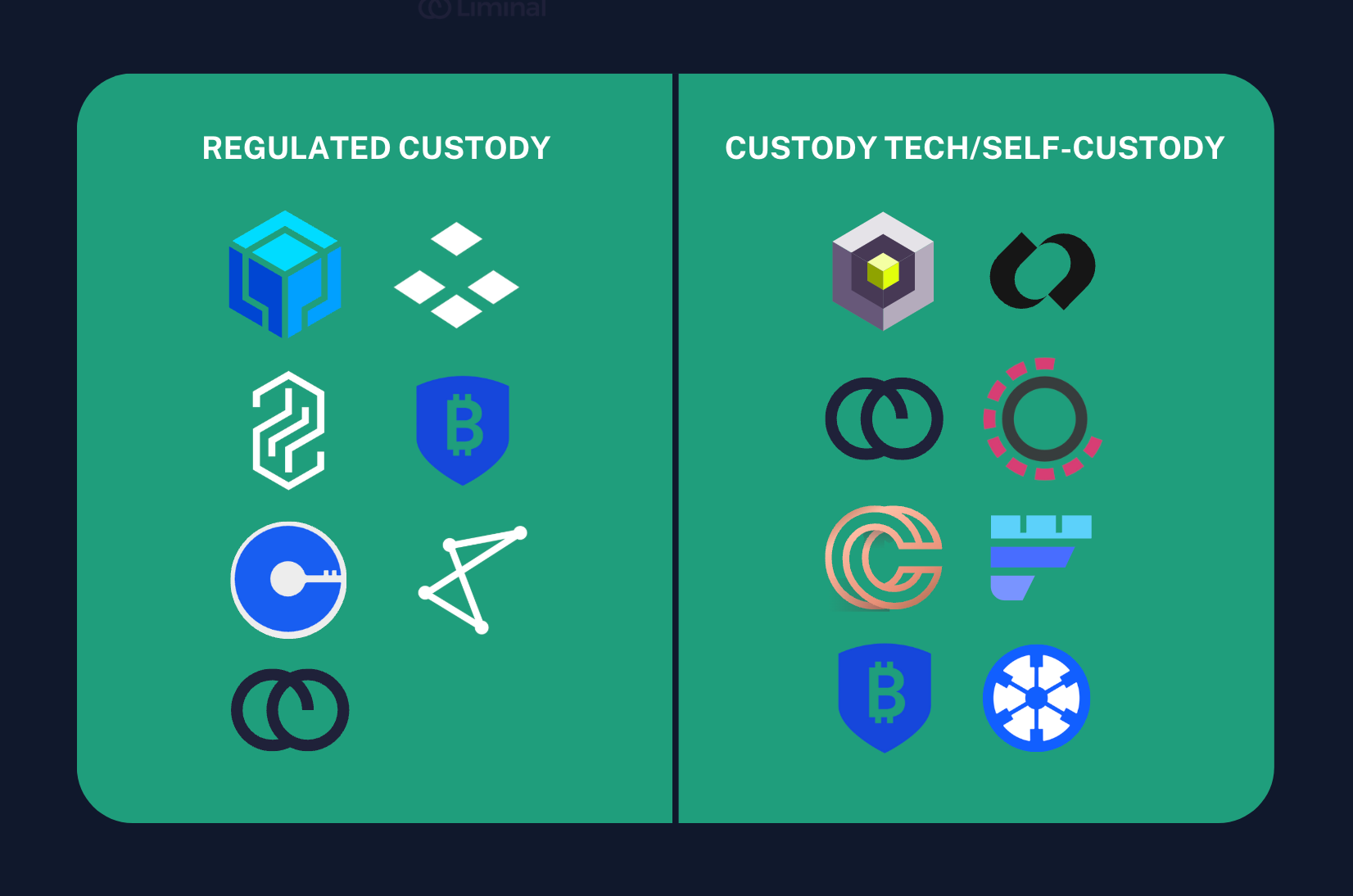
It’s that time again - time to review the leading custody solutions in the digital asset space for the year. Selecting the right solution is essential for funds, allocators, and trading teams, especially for those new to the space. With so many options to choose from, it can feel overwhelming. To simplify your decision making, we’ve created a detailed comparison of the solutions featured on our platform, Counterparty Catalogue, highlighting the features that matter most. This year, we’re gifting you not one, but two comprehensive tables: one for regulated custody solutions and another for custody tech/self-custody solutions, so you have all the insights you need to pick the solution that best fits your needs.
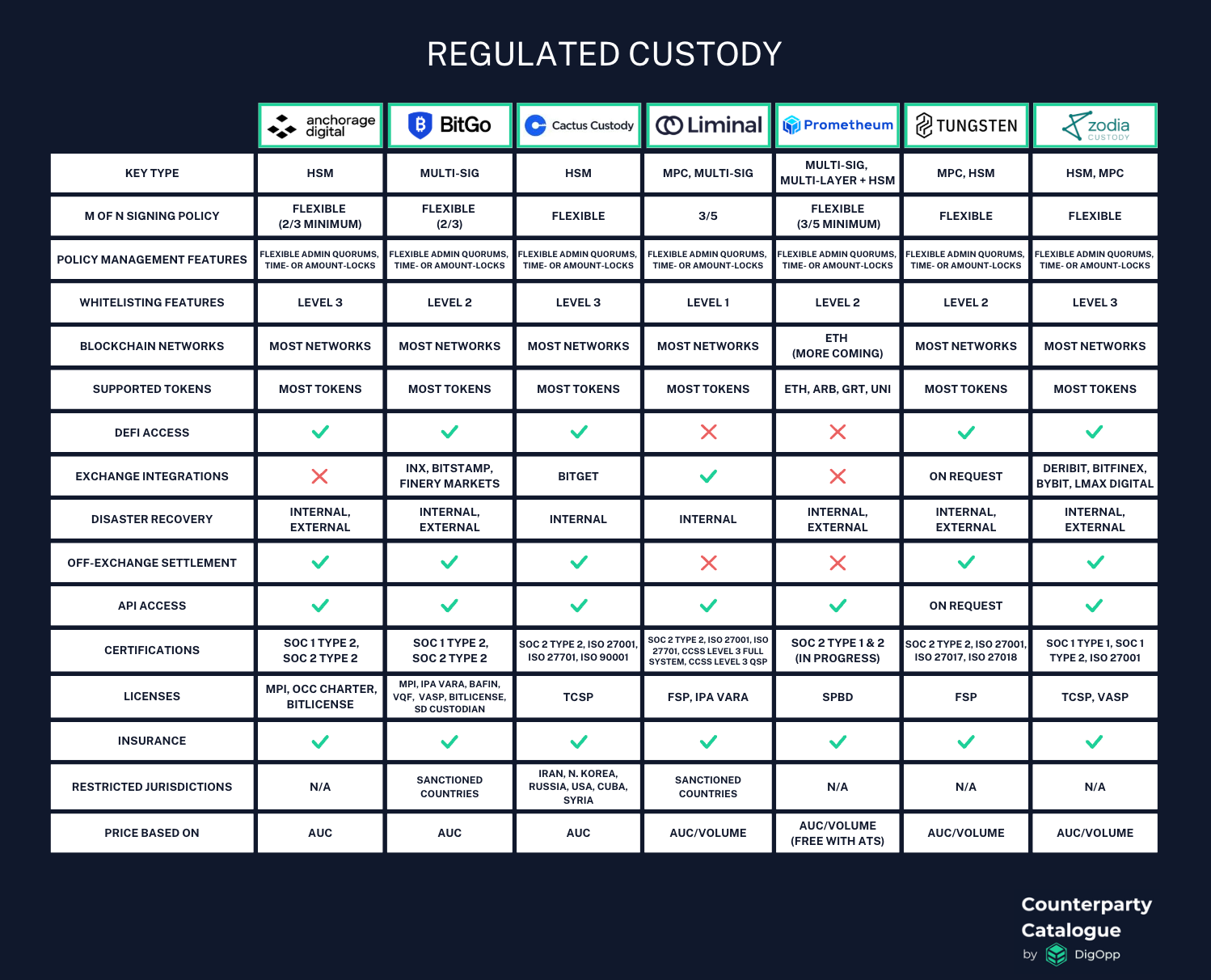
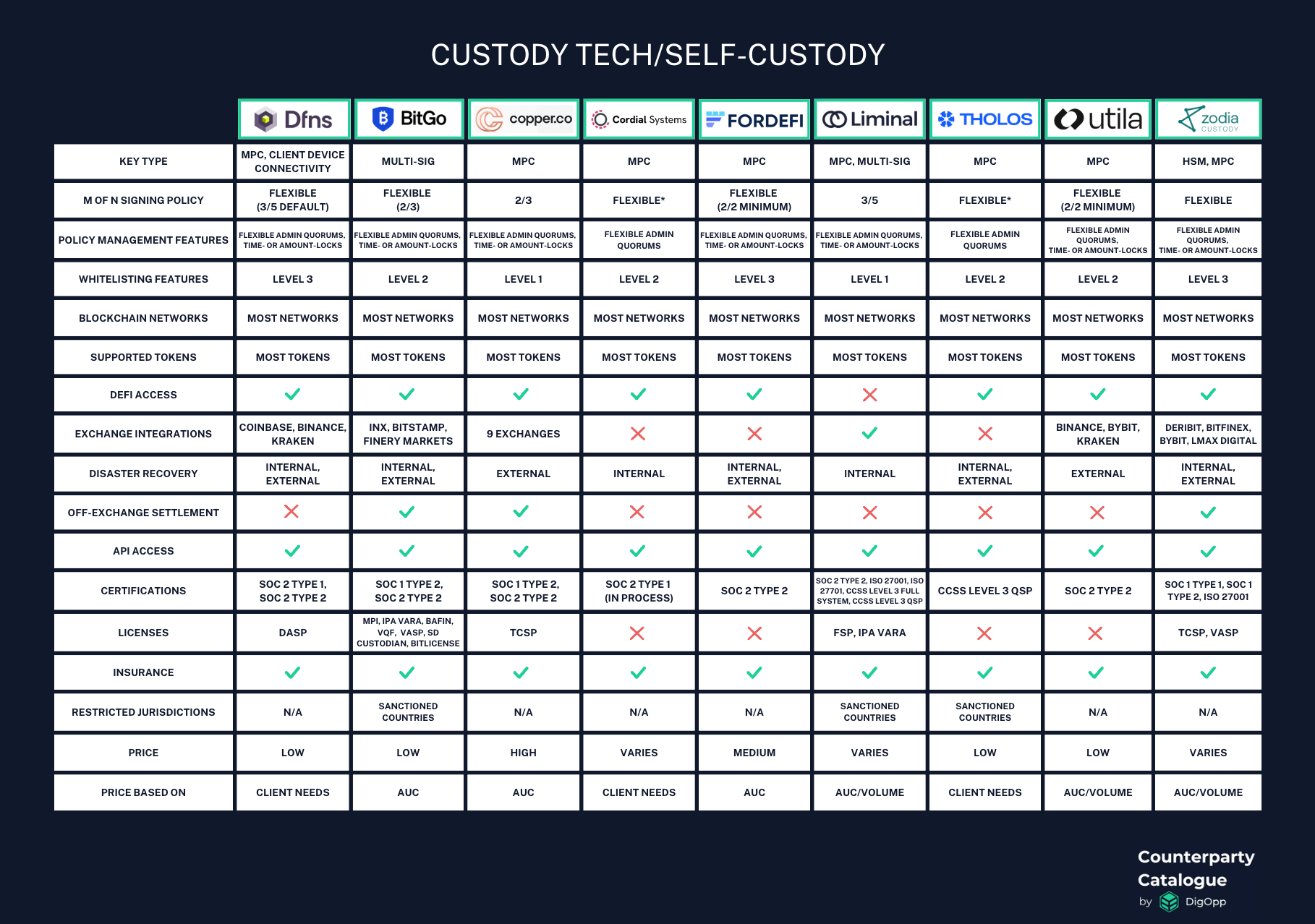
The information in these tables has been provided directly by the counterparties and/or sourced from their publicly available materials, including websites and other resources. We have not independently verified all details, including the quality of the audits listed. A full Operational Due Diligence (ODD) assessment would be required for complete verification - please reach out for assistance in evaluating these entities.
This table is for informational purposes only and should not be interpreted as an endorsement or assessment of any counterparty’s risk or reliability. Counterparty details may change over time, and we recommend verifying information with the respective companies before making any decisions.
Legend:
Regulated Custodian: Solution meets specific regulatory requirements to safely hold client assets and keys/shards.
Custody Tech/Self-Custody: Solutions that provide tools for users to manage and secure their own assets, often requiring shared or full client control of key shares.
Key Type:
HSM: A Hardware Security Module (HSM) is a physical device used to secure and manage cryptographic keys.
Multi-Sig: Wallets requiring multiple signors to authorize each transaction, enhancing security.
MPC: Multi-Party Computation (MPC) also requires multiple signors to authorize each transaction, but it involves distributing key shards among multiple parties or users. These shards of data collectively form a complete private key, rather than multiple distinct keys.
Multi-Layer + HSM: Combines multiple security layers with HSMs for advanced protection.
Client Device Connectivity: Allows integration of client’s systems, such as HSMs, into the custody solution.
M of N Signing Policy: Requires M out of N designated signatories to approve a transaction. The ratios listed in the table are the number of approvals or devices required to sign each transaction.
Flexible: Allows clients to customize the number of required signors.
* Cordial Systems and Tholos do not hold any key shares - users hold all the shares, making them true self-custody solutions. Other solutions, such as Dfns, offer flexibility, so clients can hold all key shares if preferred.
Policy Management Features:
Flexible Admin Quorums: Ability to define and modify signers, admins, required/optional signers, and policy managers (all solutions above have this).
Time- or Amount-Locks: Ability to set transaction size limits and require additional approvals if thresholds are exceeded within a certain timeframe.
Whitelisting Features: Whitelisting is a security feature that enables clients to manage permissions, reducing the risk of fraud and unauthorized access. The levels below outline the capabilities available for policy management.
Level 1: Whitelist specific blockchain addresses and tokens for sending and receiving transactions.
Level 2: Includes Level 1, plus restricts smart contract interactions to approved contracts.
Level 3: Includes Level 2, plus restricts specific smart contract functions and parameters (e.g., specific tokens swaps or settlement rules).
Blockchain Networks: Decentralized digital ledgers that support various cryptocurrencies and applications. Example: Compatibility with Ethereum Virtual Machines (EVMs) permits interaction with Ethereum and other compatible blockchains.
Most Networks: Includes Ethereum, Ethereum Layer 2s (networks built on top of base blockchains for enhanced scalability and efficiency), Other Layer 1 EVMs (base blockchains), Bitcoin, Solana, and others.
More Coming: Additional networks expected to be available this year.
Supported Tokens: The range of digital assets clients can trade, encompassing a wide range of cryptocurrencies from various blockchain layers.
Most Tokens: Broad compatibility.
DeFi Access: Capability to conduct Decentralized Finance (DeFi) transactions on-chain.
Exchange Integrations: The exchanges where clients can connect their assets to for trading.
On Request: Tungsten offers integrations with Binance, Coinbase, and Kraken upon request.
Disaster Recovery: Methods for recovering private keys in a disaster event.
Internal: Handled within the custody solution.
External: Supported through third-party integrations.
Off-Exchange Settlement: Allows users to trade on exchange while keeping their assets locked off of the exchange, mitigating exchange-related risks.
API Access: Ability to connect through Application Program Interface (API) for automation and integration with other systems.
On Request: Users can request access.
Certifications: Approvals that the platform holds, indicating the platform’s adherence to industry standards and best practices for security and privacy.
SOC 1 Type 1 & 2, SOC 2 Type 1 & 2: Audits assessing operational and security controls.
ISO 27001, 27017, 27018, 22301, 90001: International Organization for Standardization (ISO) 27001 focuses on information security management, ISO 27017 on cloud security, ISO 27018 on privacy protection, ISO 22301 on business continuity, and ISO 90001 on quality management systems.
CCSS Level 3 Full System & QSP: The Cryptocurrency Security Standard (CCSS), developed by the CryptoCurrency Certification Consortium (C4), is a framework for securing crypto systems at various levels. Level 3, the highest standard, represents advanced security measures across all aspects of operations. A Full System designation indicates that the entire infrastructure meets the requirements of CCSS Level 3. A Qualified Service Provider (QSP) signifies that the counterparty fulfills most CCSS certification requirements but excludes certain elements controlled by external systems.
In Process: Should be completed by Q2 of this year.
Licenses:
MPI: Major Payment Institution license (Singapore)
OCC Charter: Federally chartered by the U.S. Office of the Comptroller of the Currency
BitLicense: New York Department of Financial Services (NYDFS) license for virtual currency businesses
IPA VARA: In-Principle Approval under the Virtual Assets Regulatory Authority (Dubai)
VARA: Full Virtual Assets Regulatory Authority license
BaFin: Regulated custodian license (Germany)
VQF: Regulated custodian by the Financial Services Standards Association (Switzerland)
VASP: Virtual Asset Service Provider license (Europe)
SD Custodian: South Dakota Division of Banking (Qualified Custodian)
TCSP: Trust and Company Service Provider license (Hong Kong)
FSP: Financial Service Permission license (UAE)
SPBD: Special Purpose Broker Dealer license issued by FINRA
DASP: Digital Asset Service Provider license (France)
Insurance: Counterparties may have various types of insurance to mitigate risks and protect assets against unexpected events. Coverages can include: Technology Errors & Omissions (E&O), Cyber, Crime, Specie, Network Security and Privacy, Professional E&O, Directors & Officers (D&O), General Liability, and Umbrella (or Excess) Liability. More details about each counterparty’s specific coverages can be found on their profile on Counterparty Catalogue.
Restricted Jurisdictions: Countries where services cannot be offered due to sanctions or regulations.
Sanctioned Countries: The countries restricted under Office of Foreign Assets Control (OFAC) and other global or regional sanctions lists.
Price: Monthly fees range from hundreds to thousands of dollars, depending on client needs.
Varies: Pricing depends on the specific features needed by the client.
Pricing Based On: Pricing models typically scale with factors such as Assets Under Custody (AUC), transaction volume, subscription levels, or specific features.
Free with ATS: Custody solution is free for active traders using Prometheum’s trading platform.
I hope these comparisons give you a clearer picture of the crypto custody landscape for 2025. To dive deeper into each solution, be sure to explore their profiles on Counterparty Catalogue.
Upcoming Reports:
We will be releasing an Operational Due Diligence (ODD) report on Dfns this month, which users can request access to. Stay tuned on Counterparty Catalogue for the full details.
If you’re interested in ODD on specific digital asset service providers or funds, please reach out to us at info@digopp.group.
Disclaimer
We, Digital Opportunities Group Enterprises, Inc. are not providing investment or other advice. Nothing that we post on Substack should be construed as personalized investment advice or a recommendation that you buy, sell, or hold any security or other investment or that you pursue any investment style or strategy.
Case studies may be included for informational purposes only and are provided as a general overview of our general investment process. We have compiled our research in good faith and use reasonable efforts to include accurate and up-to-date information. In no event should we be responsible or liable for the correctness of any such research or for any damage or lost opportunities resulting from use of our data.
We are not responsible for the content of any third-party websites and we do not endorse the products, services, or investment recommendations described or offered in third-party social media posts and websites.
Nothing we post on Substack should be construed as, and may not be used in connection with, an offer to sell, or a solicitation of an offer to buy or hold, an interest in any security or investment product.
Love the insights and thoughts, Fozia! Would love to see the Kraken Custody (custody.kraken.com) and how it stacks up against the other players you’ve reviewed.